
Haunted House Ideas: Transform Your Home for Halloween
Table of Contents
- Haunted House Ideas: Where to Start
- DIY Haunted House Decorations You Can Build at Home
- Haunted House Room Ideas for Every Space
- Haunted House Lighting Ideas That Set the Mood
- Haunted House Ideas for Kids: Scares Without the Tears
- Your Setup Plan: Timeline, Safety and Visitor Flow
- Frequently Asked Questions
Last Updated: October 21, 2026
Haunted House Ideas: Where to Start
The best haunted house ideas start with a single theme, a fixed budget, and a clear read of your space. At J&W Novelty Toys & Bucket Hats in East Belfast, we build our own Haunted House every October, so we know how quickly half-chosen decorations turn into a muddle.

Theme first. Everything else follows from it.
Pick a Theme Before You Buy Anything
A theme ties every room together. Without one, you end up with a graveyard in the hall, a circus in the kitchen, and no coherent atmosphere. Pick one and commit:
- Victorian haunted mansion - cracked portraits, dusty drapes, candelabras, eerie wallpaper
- Abandoned graveyard - tombstones, fog, bare branches, a creeping climbing skeleton
- Mad scientist's lab - jars, tubes, a potions cellar feel, cold blue light
Once the theme is set, every prop either fits or it doesn't. That single filter saves money and makes the whole build feel intentional.
Set Your Budget and Space Limits
Work out two numbers before you shop: your spend and your square metres.
A simple way to split a budget:
| Tier | Typical Spend | What It Covers |
|---|---|---|
| Starter | Under £30 | Cobwebs, bats, one focal prop, tea lights |
| Mid | £30-£70 | Two room themes, lighting, hanging decor |
| Full | £70+ | Multiple rooms, animatronic piece, full blackout |
Measure your hallway, doorways, and rooms. A passageway under a metre wide cannot take a full-size figure, but suits hanging bats, webbed string lights, and a tactile effect at head height.
DIY Haunted House Decorations You Can Build at Home
DIY haunted house decorations do not need craft skills. The strongest builds use cheap materials, a bit of ageing, and one good light source. Layered paint, torn edges, and light placed to throw shadow separate eerie from school project. Below are five builds; total material cost sits under £25 if you own basic craft supplies.
1. Tissue Paper Ghosts
Materials: white tissue paper (3-4 sheets per ghost), a polystyrene ball or scrunched newspaper for the head, white thread, black marker, PVA glue diluted 50/50 with water.
Build: Scrunch the ball to roughly 6cm diameter. Lay three sheets of tissue flat, place the ball in the centre, and gather the paper around it.
Trade-off: Tissue ghosts are lightweight and cheap but not weatherproof. Keep them indoors or under a porch.
2. Cardboard Tombstones
Materials: double-wall cardboard (moving boxes work well), grey emulsion paint, dark grey and brown acrylic for ageing, a craft knife, a sponge.
Build: Cut slabs roughly 40cm wide by 60cm tall with a rounded top. Two coats of grey emulsion as a base.
Durability: Sealed cardboard lasts two to three seasons if stored flat and dry. Unsealed card will warp in damp air within weeks.
3. Balloon Spiders
Materials: black balloons, black card, double-sided tape, fishing line.
Build: Inflate balloons to roughly 20cm diameter. Cut eight legs per spider from black card, each about 25cm long and 3cm wide, tapering to a point.
Placement tip: Cluster spiders near a light source so they cast multiple shadows on the wall behind them. A single spider looks like a balloon; five together look like an infestation.
4. Creepy Wallpaper Panels
Materials: foam board (A2 or larger), printed portrait or damask patterns, PVA glue, a foam roller, sandpaper.
Build: Print faded Victorian portrait or damask patterns at A3 size.
Unique angle: Print the same portrait twice, once normal and once with the eyes blacked out or the mouth slightly altered.
5. Potions Cellar Jars
Build: Fill jars three-quarters with water. Add food colouring drop by drop until strong but still translucent. Add a few drops of glycerine so suspended items drift rather than sink.
Safety note: If children will handle the jars, use plastic jars instead of glass and skip the glycerine (it makes surfaces slippery if spilled).
Ageing Everything
New props look shop-bought. A wash of watered-down brown paint, a torn edge, or a dusting of flour makes a prop look decades old. Apply the wash, then wipe most off, the residue in creases and edges sells the age.
Storage and Reuse
Store card props flat, keep tissue paper in a dry box, and label each build so next October takes an hour instead of a weekend. Deflate balloon spiders and store flat; card legs reuse if kept dry. Empty and dry jars fully to prevent mould.
Haunted House Room Ideas for Every Space
Haunted house room ideas work best when each space has one job: a scare, a story, or a breather.
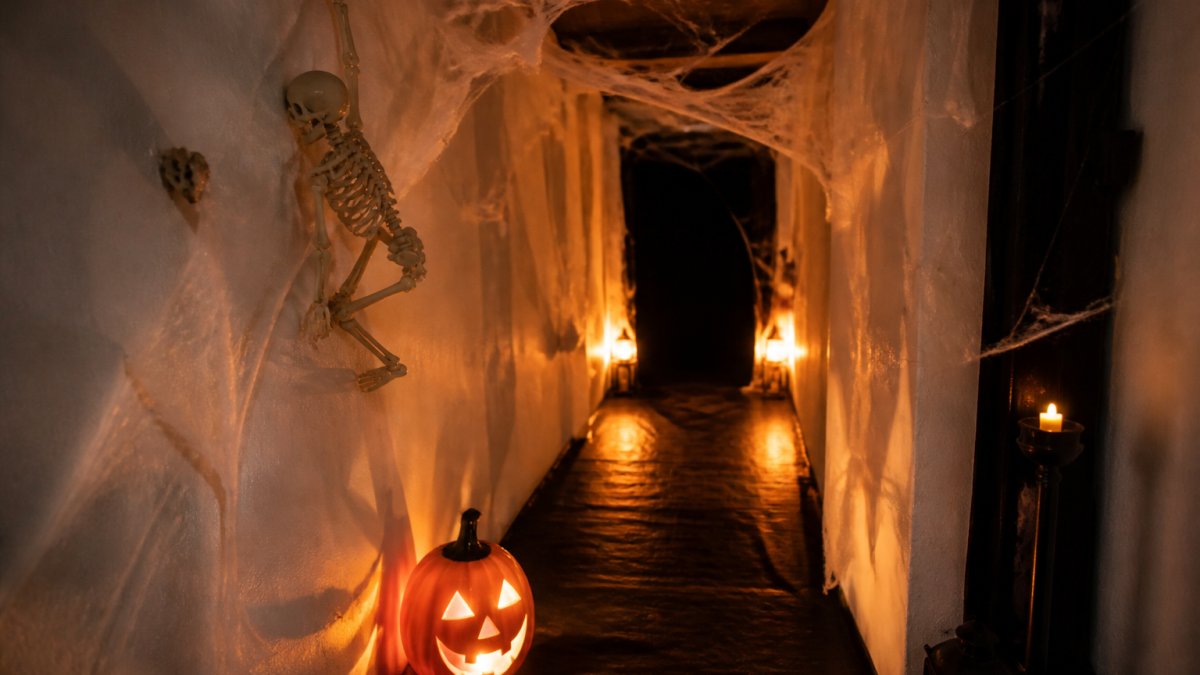
The Passageway
Job: Disorientation and tactile scares.
A narrow hallway is the cheapest room to convert and often the most effective.
Build detail: Cut 30-40 strands of black thread, each 1.5-2m long, and tape them to the ceiling at irregular intervals.
Visitor flow: The passageway should be a one-way route. If visitors can turn back, the disorientation breaks and the scare loses its power.
The Graveyard Room
Job: Atmosphere and slow dread.
Tombstones (see the DIY section), dry leaves on the floor, a low fog machine, and bare branches in corners.
Build detail: Scatter leaves loosely rather than piling them, a thin layer across the whole floor reads better than a thick pile in one corner.
Lighting: Use a single blue-grey light source behind the tombstones so they cast long shadows toward the visitor.
Book J&W Haunted House tickets: £7 each or £20 for a family of four →
The Autopsy Room
Job: Shock and clinical unease.
A table, a covered shape (a dummy or rolled fabric under a white sheet), cold white light, and clinical tools.
Build detail: Use a cheap folding table covered with a white sheet. Place a dummy underneath, draped so the shape is ambiguous.
Age-appropriate note: This room is the one to mark as skippable for younger visitors.
The Victorian Parlour
Job: Story and slow-burn unease.
Dusty furniture, framed portraits with moving eyes, a ticking clock. This room rewards visitors who look closely.
Build detail: Source frames from charity shops. Print portraits at A4 and mount behind the glass.
Sound: A ticking clock is essential. A real clock works, but a phone playing a ticking sound on loop is more controllable and can be hidden behind furniture.
The Potions Cellar
Job: Wonder and colour.
Shelves of glowing jars, a bubbling cauldron, green light.
Build detail: Use the potions jars from the DIY section. Arrange on shelves at varying heights.
Trade-off: This room is the most fragile, jars can be knocked over. Place shelves above waist height and secure the cauldron to the floor with tape.
Small Spaces and Renter-Friendly Setups
Renters and small flats can still build a proper haunt by working vertically with removable fixings.
Command strips, tension rods, and freestanding frames leave no marks.
Unique angle: Most guides assume a whole house. This loop approach works in a studio flat, a single garage, or even a large shed.
Room Sequence and Visitor Flow
Room order matters as much as the rooms. A common pattern:
- Entry, low-intensity, sets the theme
- Passageway, tactile disorientation
- Graveyard, atmospheric dread
- Autopsy or Parlour, peak scare
- Potions Cellar, wonder and relief
- Exit, calmer, so visitors leave laughing
Leave a short gap between groups so each experiences the scares fresh. Place your strongest scare where the path narrows, visitors are already alert in tight spaces.
Haunted House Lighting Ideas That Set the Mood
Haunted house lighting ideas decide whether a room feels eerie or just dark. One strong light source per room beats six weak ones.
The core kit:
- Black light - makes white and neon props glow, perfect for hidden messages and painted handprints
- Flickering pumpkin - warm, unsteady light that reads as candlelight
- Paper lanterns - soft ambient fill so visitors can still see where they are walking
Black Lights, Flickering Pumpkins and Glow in the Dark
Black lights need darkness. If white light leaks in, the effect disappears, cover windows, kill overhead bulbs, and let the UV work.
Paint glow in the dark details a day ahead so they charge fully. A flickering pumpkin placed low throws shadows upward, far creepier than light from above.
Haunted House Ideas for Kids: Scares Without the Tears
Haunted house ideas for kids need a different rulebook: a thrill, not a fright that ends the night in tears.
What works for younger visitors:
- Cute over creepy - friendly ghosts, smiling pumpkins, silly skeletons
- Touch, not shock - bowls of cooked spaghetti as "worms", peeled grapes as "eyeballs"
- Sound and light, not jump scares - a creaking door, a flickering lantern, a giggling ghost
Keep the scariest props in one room and mark the route so families can skip it.
Novelty toys make brilliant kid-friendly props and prizes. Our Giant Ghost Squishy is a soft, boxed ghost with pink cheeks and purple detailing, suitable for ages 6 and up, and doubles as a sensory toy after Halloween.
Your Setup Plan: Timeline, Safety and Visitor Flow
A haunted house built in one afternoon looks like it. Spread the work across two weeks and the finish improves dramatically.
| When | Task |
|---|---|
| 2 weeks out | Choose theme, measure spaces, set budget |
| 10 days out | Buy core props and lighting |
| 1 week out | Build DIY props, age and paint them |
| 3 days out | Test lights, charge glow paint, run a full walkthrough |
| Day before | Final dress, cable check, safety sweep |
| Event day | Lights on, fog on, doors open |
Safety comes first on the night. If you are charging admission, check current guidance on event safety and fire precautions before you open.
Visitor flow decides how good the haunt feels.
Building a haunt that genuinely works takes planning, the right props, and a theme you stick to. Book J&W Haunted House tickets (£7 each, or £20 for a family of four) and walk through ours, or pick up a Halloween Mystery Bag: 5 Surprise Items for £20 to add to the fun at home.

Frequently Asked Questions
What should you put in a haunted house to make it feel spooky?
Start with lighting: swap white bulbs for orange or purple mood lighting and add a black light to make white fabrics and glow-in-the-dark props stand out. Layer in texture with tissue paper ghosts, webbed string lights, cobwebs and hanging bats. A climbing skeleton, tombstone props and a flickering pumpkin give visitors something to spot around every corner. Sound matters too, so a cheap speaker playing wind or creaking floorboards finishes the haunted house effect without much extra spend.
How do you make a haunted house less scary for children?
Stick to spooky-cute rather than genuinely frightening. Use friendly ghosts, smiling pumpkins and cute plush characters instead of gore or sudden loud noises. Keep the lighting dim but not pitch black, and let children walk through with an adult. Avoid jump scares and masked actors for younger visitors. A gentle room theme, such as a potions cellar with glowing bottles, gives the Halloween feel without causing upset. Plush horror toys suited to ages 3 and over are a good example of spooky-cute done well.
How can you create a haunted house on a budget?
Focus on lighting and fabric first, since these change a room's mood for very little money. Bin bags, tissue paper and old sheets become ghosts and drapes. Cardboard boxes cut into tombstone shapes and painted grey make a graveyard scene for almost nothing. Reuse items year after year and add one or two new props each October. A Halloween Mystery Bag at £20 contains five surprise items, which is a simple way to grow your prop collection without picking everything individually.
What happens at the J&W Haunted House in East Belfast?
The J&W Haunted House on the Newtownards Road is open every day from 19 to 31 October 2026, 5pm to 9pm. Tickets are £7 per person, or £20 for a family of four, and they are available in the shop or online. Your booking confirmation email acts as your ticket, so show it on arrival. It is a walk-through experience with themed rooms and lighting effects. If you are planning your own haunted house ideas at home, visiting first is a useful way to see what works.